

What happens when parents can’t agree on custody arrangements for their children?
This is a question many parents face during divorce or separation, and it’s a complex issue that involves understanding family court processes and custody laws. Navigating this challenging time requires a clear understanding of what to expect from the legal process.
The article will guide you through the intricacies of the child custody legal process, providing insights into the laws that govern custody decisions and the steps involved in the family court process.
Key Takeaways
Table of Contents
- Understanding the basics of child custody laws
- The role of the family court in custody decisions
- Steps to prepare for the legal process
- Factors that influence custody arrangements
- Tips for navigating the court system effectively
Understanding Child Custody Basics
Understanding the different types of child custody arrangements is crucial for parents going through a divorce or separation. Child custody laws are designed to protect the best interests of the child, and knowing how these laws work can help parents make informed decisions.
Types of Custody Arrangements
Custody arrangements can vary significantly depending on the circumstances of the parents and the child. The main types include sole custody, joint custody, split custody, and bird’s nest custody.
Sole Custody vs. Joint Custody
Sole custody grants one parent the primary responsibility for the child’s care, while joint custody involves both parents sharing decision-making responsibilities. Joint custody does not necessarily mean equal time with the child.
Split Custody and Bird’s Nest Custody
Split custody involves dividing siblings between the two parents, while bird’s nest custody allows the child to remain in one home, with the parents alternating living there. These arrangements are less common but can be tailored to fit the family’s needs.
Legal Custody vs. Physical Custody
It’s essential to distinguish between legal custody and physical custody. Legal custody refers to the right to make decisions about the child’s upbringing, education, and healthcare. Physical custody, on the other hand, pertains to the child’s living arrangements.
Best Interest of the Child Standard
Courts use the “best interest of the child” standard to make custody decisions. This involves considering factors such as the child’s relationship with each parent, the child’s needs, and the parents’ ability to provide a stable environment.
- The child’s physical and emotional needs
- The parents’ ability to cooperate
- The child’s preference, depending on their age
By understanding these basics, parents can better navigate the child custody legal process and work towards arrangements that benefit their child.
The Child Custody Legal Process Step-by-Step
Understanding the child custody legal process is crucial for parents seeking to establish a custody arrangement. This process involves several key steps, from the initial filing to the final judgment, and requires a comprehensive understanding of legal procedures and requirements.
Filing the Initial Petition
The first step in the child custody legal process is filing the initial petition. This document outlines the custody arrangement being sought and is typically filed in the family court of the county where the child resides.
Where to File and Jurisdiction Issues
Jurisdiction is a critical factor in determining where to file the custody petition. Generally, the court with jurisdiction is the one in the child’s home state or where the child has significant connections. It’s essential to consult with an attorney to ensure the petition is filed in the correct jurisdiction.
Service of Process Requirements
After filing the petition, the next step is serving the other parent with the court documents. This process, known as service of process, must be carried out according to the laws of the state, typically by a process server or law enforcement officer.
Required Documentation and Forms
The child custody legal process requires various documents and forms, including the petition for custody, financial affidavits, and parenting plans. Accurate and complete documentation is vital to support your custody case.
A detailed table outlining the typical documents required is provided below:
| Document | Description | Purpose |
|---|---|---|
| Petition for Custody | Outlines the custody arrangement being sought | Initiates the custody case |
| Financial Affidavit | Discloses financial information of both parents | Used for determining child support |
| Parenting Plan | Details the proposed custody and visitation schedule | Helps the court understand the proposed arrangement |
“The key to a successful custody case is preparation and understanding of the legal process.”
Temporary Custody Orders
During the custody proceedings, one or both parents may request a temporary custody order. This order provides a temporary arrangement until the final custody decision is made.
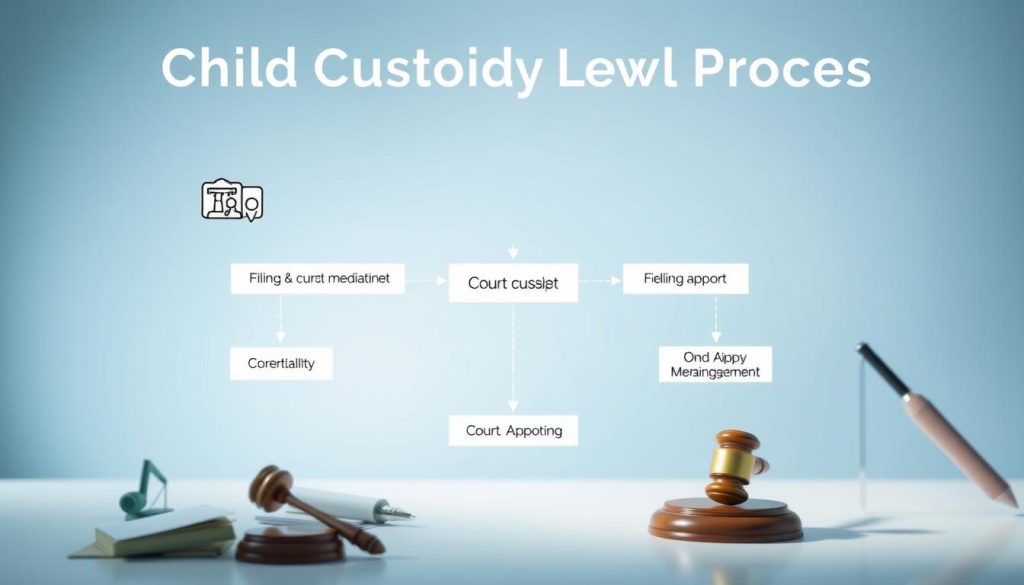
Temporary custody orders can be crucial in maintaining stability for the child during the legal process. It’s essential to work with an attorney to ensure that the temporary order aligns with your long-term custody goals.
Navigating Court Proceedings
Understanding the intricacies of court proceedings can significantly impact the outcome of a child custody case. Court proceedings involve several steps, from preparing for hearings to understanding the roles of various court professionals.
Preparing for Court Hearings
Preparation is key to successfully navigating court hearings. This involves gathering evidence and documentation that supports your custody case.
Gathering Evidence and Documentation
It’s essential to collect relevant documents, such as records of interactions with your child, proof of your ability to provide a stable environment, and any other evidence that demonstrates your suitability as a custodial parent. Organizing these documents in a coherent manner will help present a strong case.
Working with Your Attorney
Your attorney plays a crucial role in guiding you through the court proceedings. They will help you understand the legal requirements, prepare you for testimony, and represent your interests in court.
What to Expect During Custody Hearings
During custody hearings, both parties will have the opportunity to present their case. The court will consider various factors, including the child’s best interests, parental capabilities, and any history of abuse or neglect.
Understanding the Role of Family Court Professionals
Family court professionals, including judges, mediators, and guardians ad litem, play significant roles in custody cases. Understanding their roles can help you navigate the process more effectively.
| Professional | Role |
|---|---|
| Judge | Makes the final decision regarding custody arrangements based on the evidence presented. |
| Mediator | Helps facilitate an agreement between parties without making a decision. |
| Guardian ad Litem | Investigates and reports on the best interests of the child. |
Mediation and Alternative Dispute Resolution
Mediation is increasingly recognized as a valuable tool in resolving child custody disputes without the need for lengthy court battles. This approach allows parents to work together with a neutral third-party mediator to reach a mutually acceptable custody arrangement.
Benefits of Child Custody Mediation
Child custody mediation offers several key benefits, including reduced conflict between parents, more control over the outcome, and a faster resolution compared to traditional litigation. Mediation also tends to be less expensive and can help preserve a more positive co-parenting relationship.
By focusing on cooperation rather than confrontation, mediation can lead to more sustainable and satisfactory custody arrangements for all parties involved, especially the children.

The Mediation Process Explained
The mediation process typically begins with an initial consultation to understand the issues and goals of both parents. The mediator then facilitates a series of discussions, helping the parents to identify common ground and work towards a comprehensive custody agreement.
This process is flexible and adaptive, allowing it to be tailored to the specific needs and circumstances of each family.
When to Consider Collaborative Law or Arbitration
While mediation is a powerful tool, there are situations where alternative dispute resolution methods like collaborative law or arbitration may be more appropriate. Collaborative law involves a team of professionals working together to help parents reach a custody agreement without going to court.
Arbitration, on the other hand, involves a neutral third-party making a binding decision on custody arrangements. Both methods offer alternatives to traditional litigation and can be effective in certain circumstances.
Creating and Implementing Custody Arrangements
A well-crafted custody arrangement is essential for the well-being of the child and the peace of mind of both parents. This critical step in the child custody legal process involves careful planning and cooperation between parents to ensure the child’s needs are met.
Developing a Comprehensive Parenting Plan
Developing a comprehensive parenting plan is a crucial aspect of creating an effective child custody agreement. This plan should outline how parents will share responsibilities and make decisions for their child.
Essential Components to Include
A comprehensive parenting plan should include details such as:
- Residence arrangements for the child
- Visitation schedules
- Decision-making processes
- Communication protocols between parents
These components help ensure that both parents are on the same page and that the child’s needs are prioritized.
Addressing Special Circumstances
Special circumstances, such as a child’s special needs or a parent’s work schedule, should be taken into account when developing the parenting plan.
“A good parenting plan is flexible and adaptable to the changing needs of the child and the circumstances of the parents.”
Enforcing Custody Orders
Once a custody arrangement is in place, it’s crucial to understand how to enforce it. If one parent fails to comply with the agreed-upon terms, the other parent can seek legal recourse. Courts take violations of custody orders seriously and may impose penalties on the non-compliant parent.
Modifying Custody Arrangements
As circumstances change, it may be necessary to modify the existing custody agreement. This could be due to a change in a parent’s work schedule, relocation, or other significant life events. To modify the arrangement, parents must petition the court, providing evidence to support the requested changes.
By understanding how to create, implement, and modify custody arrangements, parents can work together to provide a stable and loving environment for their child, even in the face of changing circumstances.
Conclusion
Navigating the child custody legal process can be complex, but understanding the key elements can significantly impact the outcome of your case. By grasping the basics of child custody laws and the steps involved in the legal process, you can better advocate for your parental rights in a custody battle.
The child custody legal process involves several critical steps, from filing the initial petition to creating and implementing custody arrangements. Throughout this process, it’s essential to be aware of the factors that influence custody decisions, such as the best interest of the child standard.
By understanding child custody laws and the legal process, you can make informed decisions and work towards a resolution that prioritizes the well-being of your child. Whether through mediation or court proceedings, being prepared and knowledgeable about your rights and responsibilities is crucial.
FAQ
What is the primary consideration for courts when making child custody decisions?
The primary consideration is the “best interest of the child” standard, which involves evaluating various factors to determine the most suitable custody arrangement for the child’s well-being.
What are the different types of child custody arrangements?
The main types of custody arrangements are sole custody, joint custody, split custody, and bird’s nest custody, each with its unique characteristics and implications for the child’s care and parental involvement.
How does the court determine whether to grant sole or joint custody?
The court considers factors such as the parents’ ability to cooperate, their geographical proximity, and the child’s needs when deciding between sole and joint custody.
What is the difference between legal custody and physical custody?
Legal custody refers to the right to make decisions about the child’s upbringing, education, and healthcare, while physical custody determines where the child will live and the day-to-day care they will receive.
Can a custody arrangement be modified after it has been established?
Yes, custody arrangements can be modified if there is a significant change in circumstances or if the current arrangement is no longer in the best interest of the child.
What is the role of mediation in child custody disputes?
Mediation is a process where a neutral third-party facilitates negotiations between parents to reach a mutually acceptable custody arrangement, helping to reduce conflict and promote cooperation.
How can parents enforce a custody order if the other parent is not complying?
Parents can seek enforcement through the court by filing a motion for contempt or other enforcement actions, which may result in penalties or modifications to the existing custody order.
What factors are considered when determining the best interest of the child?
The court considers factors such as the child’s physical and emotional needs, the parents’ ability to provide a stable environment, and the child’s relationship with each parent when determining the best interest of the child.
Can grandparents or other relatives seek custody or visitation rights?
Yes, grandparents or other relatives may seek custody or visitation rights in certain circumstances, such as when the parents are unfit or unable to care for the child.
How does the court process work for child custody cases?
The court process typically involves filing a petition, serving the other parent, attending hearings, and potentially participating in mediation or other alternative dispute resolution methods to resolve the custody dispute.